Running a Studio on Two Continents
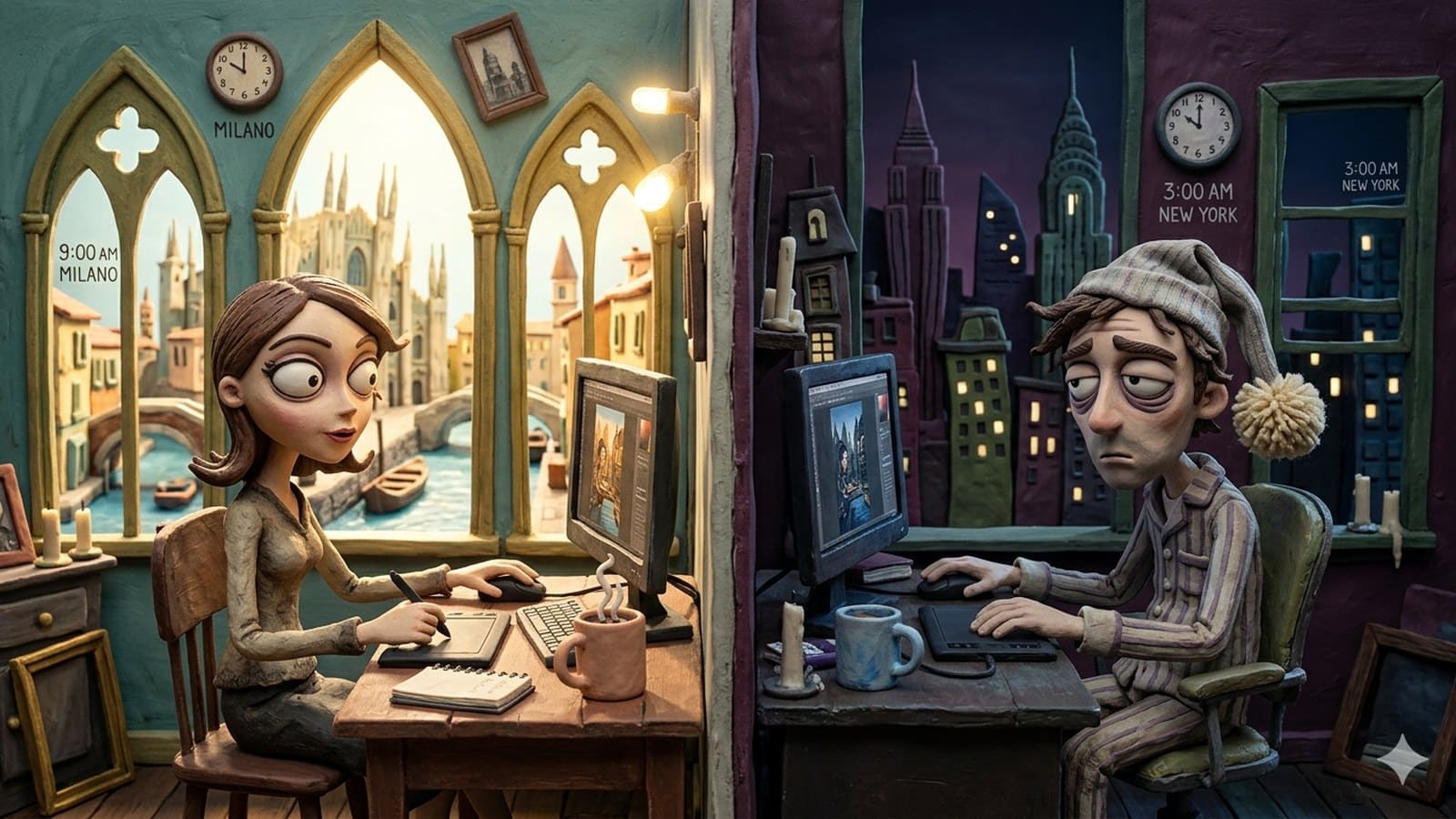
How many times, especially in the early days of the American adventure, before the machine was well-oiled, did I hear the phone ring at 3 in the morning because it was already 9 in Milan and the workday was starting? Too many to count, and too many to count the saints of paradise I disturbed with my curses. But as we say in Milan: “T’è vorsù la bicletta? Dèss pedala!” (you wanted the bicycle? Now pedal!). And dutiful, as a Milanese / New Yorker imbruttito (Milanese slang for a hardened, no-nonsense local), I pedalled hard. Especially uphill.
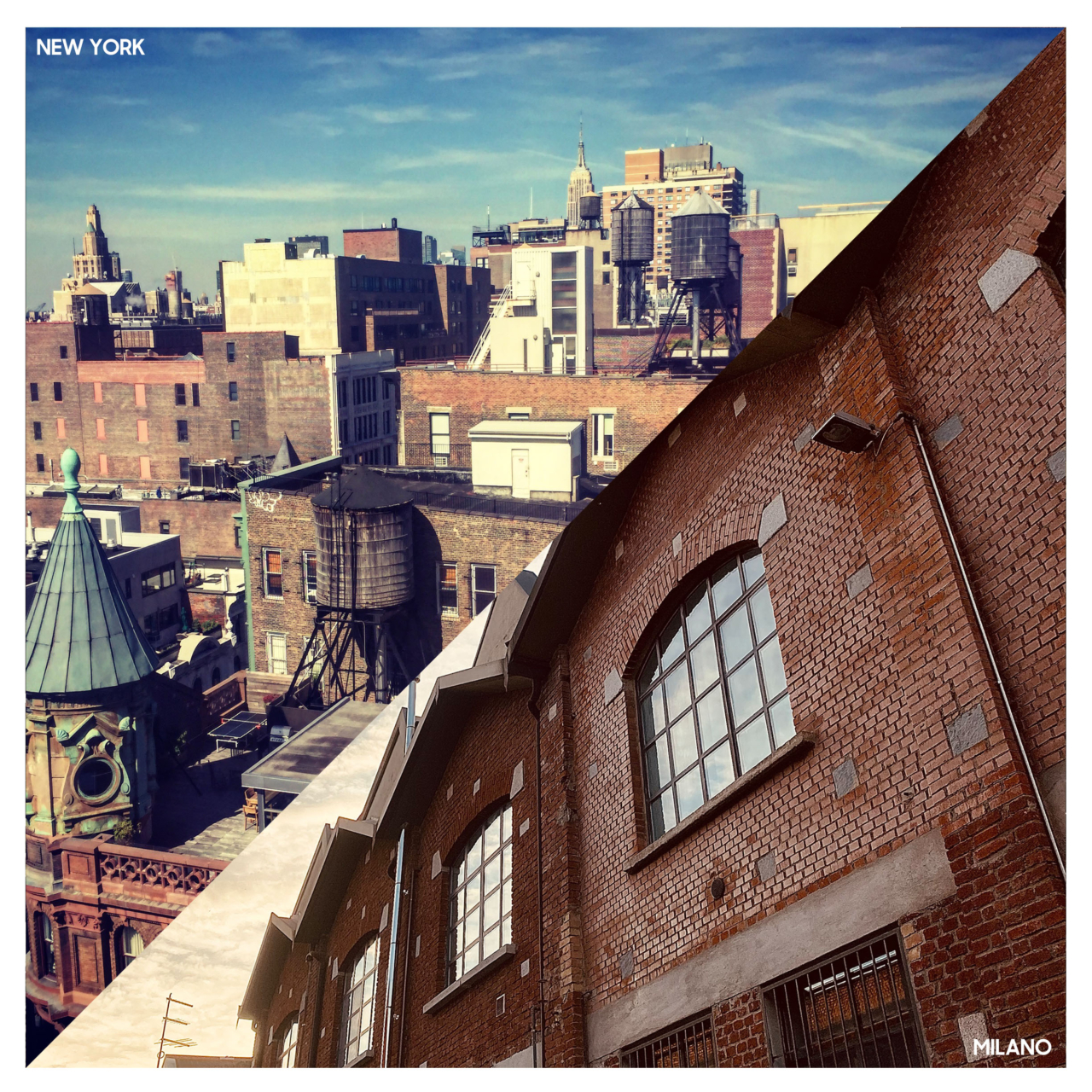
Even today it isn’t always clear to my clients, and often not even to me, where I am, when projects take me back to Europe. Every call, every WhatsApp begins with “maaaaaa where are you, Milan or New York?”. I’m so used to it I don’t notice anymore. Actually, I take pride in the privilege and the burden of being on either side of the pond, as they say here. And let’s admit it: every once in a while, playing it rockstar feels good.
Jokes aside, some features of double-continent presence are tricky to understand and to exploit. Setting up phone queues so they ring at the right time on the right extensions, choosing the invoice currency, managing bank accounts in € and in $: things I had to learn as quickly as possible so Digital Area could operate across three time zones with a shared, functional platform for the three teams we have: Milan, New York, Los Angeles.
The time zone as advantage
We’ve learned that, used properly, the time zone is an advantage our competitors don’t have. Our infrastructure has the solidity and security of a bank, and the ease of use our operators handle is so high that we can afford the luxury of taking on jobs in Italy or in New York with timelines that would turn anyone else pale. For us, it’s the daily bread.
An example. A job that starts in the afternoon in Milan, we continue in New York. When it’s time in Milan to pull down the cler (Milanese slang for the shop shutters) and head home at 6pm, here it’s still noon, and we have plenty of time to push the project forward. If we can’t finish by closing time, Chiara in Los Angeles picks it up with another 3 hours of useful work. And when it’s 6pm in LA, it’s already 3am in Milan. Six hours later, the cycle starts again.
Add that everyone at Digital Area was trained by me, works the same way, on the same monitors calibrated to the same shared profile. The result is a complete cycle that puts even the biggest studios in difficulty. Advantages built over years, achievable by others only with costs too high to justify.
Double accounting
When I started here, I found an entrepreneurial environment so fertile and so easy to read I could hardly believe it. I still remember the list of questions I brought to my CPA, the American accountant, that covered all the operations that in Italy wouldn’t have been possible for me. At the fourth “yes, you can do that” Ben (his name) asked me: “why do you keep asking these questions, of course the answer is yes”. I told him I was asking everything I couldn’t have done in Italy. He, stunned: “but how do you do business in Italy?”.
Good question. Why do you think I fought tooth and nail to open in New York?
Anecdotes aside, the double accounting and the total separation between the two companies, Italian and New Yorker, was a serious challenge at first. It meant important changes in the company structure and doubled expenses for accounting and legal support. I was lucky to have clients and friends who pointed me to the right people on both continents, and after a hard start we landed on a solid balance. What I can say is that here you can’t do things all’italiana (Italian-style, patching things together), trusting in some kind of amnesty or in administrative slowness. Here you need to have your ducks in a row for everything. You don’t improvise as an entrepreneur.
Work visas
Speaking of paperwork, the work visa is non-negotiable and MUST be tied to your principal activity. To every Italian who came over and asked me for advice, I’ve always said the same thing: don’t do things by half, follow the law to the letter, don’t look for shortcuts. The shortcuts of that kind don’t exist here.
Everyone who tried to play smart thinking “well, they won’t notice” got caught sooner or later, and their dreams shattered against a wall too high to climb. They had to go back to Italy with their tail between their legs, often complaining (as we Italians know how to do all too well) about the “excessive American rigidity”.
Here, rigidity is seen as a virtue. The rules are dozens of times less stringent than the Italian ones, but unlike ours, they aren’t open to interpretation. You have a very wide field within the rules, but the moment you step outside, you’re done, if they notice. And they always notice.
Why I love Uncle Sam
After building a flourishing business, we had to face Covid in a country I still didn’t know well. It was a massive test. Like almost everyone, we asked the state for help. I was expecting a bureaucratic catastrophe in a language not our own, with completely different procedures.
Instead, to my great surprise, we received enormous help from Uncle Sam, with a simplicity in the request that left me speechless. A single-page form, 10-12 fields, a wait of about two weeks for disbursement of the relief fund, in two tranches. The state set it up, building an extremely easy-to-use website in record time.
Want the comparison with Italy? The relief fund I got in Italy barely covered two weeks (weeks, not months) of just my collaborators’ salaries, not counting rent and utilities. If in America I hadn’t received the help we did, all my Italian savings combined wouldn’t have been enough to stay open. I would have had to close Digital Area Milan and send everyone home. Luckily we kept working, and no one suffered the consequences.
How we worked during Covid
In Italy, by mid-February 2020 you could already smell something really bad coming. In tandem with our IT, we worked out a solution that would let us run our workflow remotely. We landed on a private cloud, 256-bit encrypted, that didn’t rely on any of the major platforms (Dropbox, Google Drive, OneDrive): too slow for the volume of data we handle, which often runs into terabytes.
By the end of February we had already started moving operators home, providing computers, Wacom monitors and NAS so they had a complete workstation as if they were in our studio. We built on the ability to share a single colour profile, taking inspiration from devices used for remote medicine, which have infinitesimal colour tolerances. International Women’s Day, March 8th, marks the boundary between the old company organisation and the new: all remote or almost, hybrid presence in the studio, full flexibility. Single requirement: fibre optic internet.
Digital Area took those difficult years to sharpen its processes, today so precise they can face any future productivity challenge. Our notary network lets us scale from the current 8 operators to up to 14 with an activation time of less than 4 days. Covid tested us, but it also made us much more resilient than we imagined.
Closing
Keeping your feet on two continents is triple the work for double the revenue. It’s still worth it, but only if you have a reason that goes well beyond the bottom line. Offering your clients something that only you, or very few others, can do.
PS. This post was written by a human.